I’m excited to be studying and transitioning into data science after my recovery journey.
Graph theory and data science have become a big passion for me — it’s amazing how networks connect everything from people to information.
This is one of my favorite projects so far — analyzing a real-world network to find hidden leaders!
Thanks for checking it out. More to come soon!
CAVIAR Network Analysis Project (MIT MicroMasters Coursework)
Summary:
In this project, I analyzed a dynamic network dataset, focusing on identifying key influential nodes using network centrality measures such as betweenness, closeness, and degree centrality.
The goal was to detect the “mastermind” within the network by analyzing the flow of information and the strength of connections.
I built visualizations and computed network metrics using Python (NetworkX, matplotlib).
Skills demonstrated:
Graph Theory, Data Wrangling, Social Network Analysis, Python Programming
Insights and Reflections:
One of the most fascinating aspects of this project was observing how the network evolved over time.
Initially, authorities monitored the network quietly, but once arrests began, the criminal structure adapted — paths within the network shifted, and new communication patterns emerged.
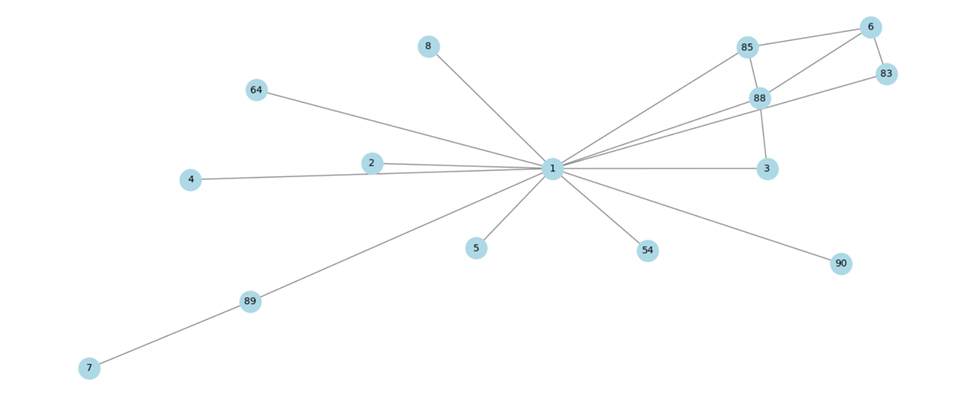
Through the centrality analysis, it became clear that Node 1 was the primary mastermind, supported by Henchman 3 and financial operations managed by Node 85.

Networks are a rich field of study, representing relationships through nodes and edges.
Like the evolving structure of the Internet, network science is rapidly developing, and new methods for analyzing dynamic systems are appearing all the time.
This project provided one example of how data-driven network analysis can help uncover hidden structures in a real-world “cops versus crime” scenario.
This project is based on the network analysis case study described in “Modeling Verdict Outcomes using Social Network Measures: the Watergate and Caviar Network Cases” (PLOS ONE). The analysis and interpretations presented here are my own work based on the data and problem structure.
I also recently picked up the book “Networks” by Newman — it’s a fascinating read, almost like reading a story!
It’s wild to realize that even though I studied graph theory during my undergraduate and graduate work, so many of these network science concepts feel entirely new.
It’s exciting to see how the field keeps evolving, and I’m looking forward to diving even deeper into graph theory, network analysis, and data science.
 Dave Keller